Training Is Not Change Management - It’s the Illusion of It
At this year’s Passion for Projects – 15 Years conference, ACMP Sweden board member Terhi Benjaminsson highlighted an uncomfortable - but deeply familiar - pattern present in almost every organization - Training Is Not Change Management - It’s the Illusion of It.
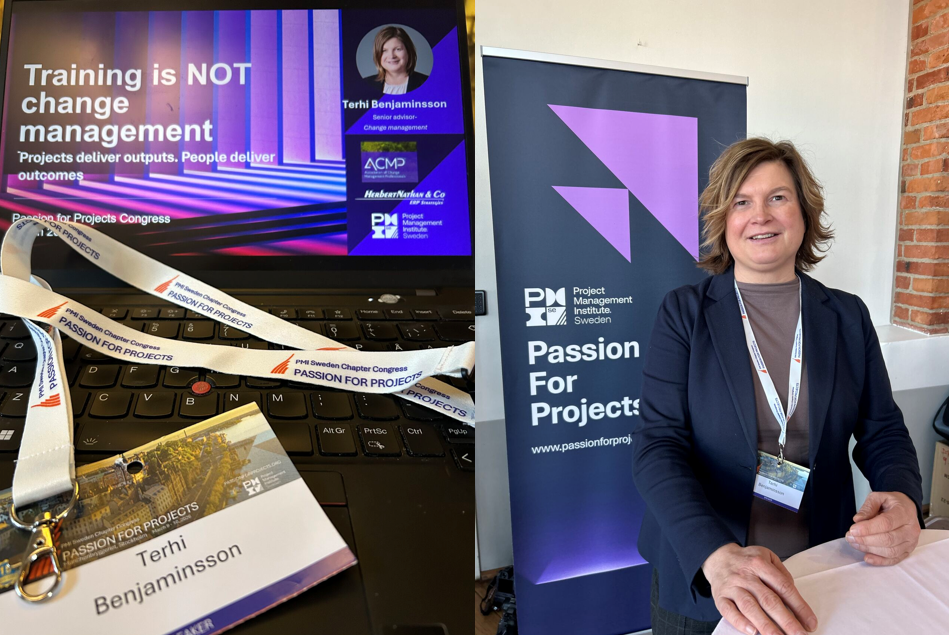
We celebrate projects as successful:
✔ Delivered on time
✔ Delivered on budget
✔ Training completed
…and yet no one talks about what happens a few months later:
Nothing has changed. Old behaviors return. The promised value never materializes.
Why? Because we keep repeating the same mistake: We treat training as the change.
The Hard Truth: Training Solves Only One Fifth of the Problem
Many organizations still rely on training as the primary strategy to drive adoption. But according to the ADKAR model, training addresses only one of the five required building blocks:
A – Awareness: Why must we change?
D – Desire: Do I want to take part?
K – Knowledge: How do I do the new thing?
A – Ability: Can I apply it in real life?
R – Reinforcement: Is the new behaviour supported over time?
Training answers just one narrow question: “Do people know how to do the new thing?”
It does not create willingness. It does not build ability. It does not sustain reinforcement. Relying on training alone is like handing someone a map and expecting them to start hiking—without ever convincing them why they should leave the couch.
Real Change Requires More Than Knowledge
Successful organizational change requires answering deeper, far more complex questions
Do people actually want to change?
Do our KPIs reward the behaviors we expect?
Are leaders modeling the new way of working?
Is the organization designed for the new way—or for the old one?
If KPIs reinforce old habits, if leaders don’t walk the talk, and if systems still support yesterday’s processes - people will continue doing what is easiest.
Knowledge increases. Behavior does not.
People Don’t Resist Change—They Resist Systems That Don’t Support It
The challenge isn’t “resistant employees.” The barriers are structures, incentives, and leadership behaviors that pull people back into old patterns.
This is why so many projects report green delivery status but red on value realization:
They’re designed for delivery, not adoption.
They measure output, not outcome.
Key Takeaways from the Session
1. Training does not create adoption. It supports knowledge - not behavior change.
2. Delivery does not create value. Value comes from people using the new ways of working.
3. Projects deliver solutions - people deliver results. And people change only when the environment, leadership, and incentives support them.
The Shift We Need
If we want transformation projects to succeed, we must:
Design for behavior change, not just knowledge transfer
Engage and equip leaders early as active role models
Align systems, structures, and KPIs to the new ways of working
Reinforce new behaviors continuously after go-live
Only then can we create sustainable, measurable, and real results.
ACMP Sweden Board Member Terhi Benjaminsson is a senior advisor in change management and learning organizations. She helps public and private sector organizations move beyond training and system delivery to build real execution capability in complex digital HR transformations.